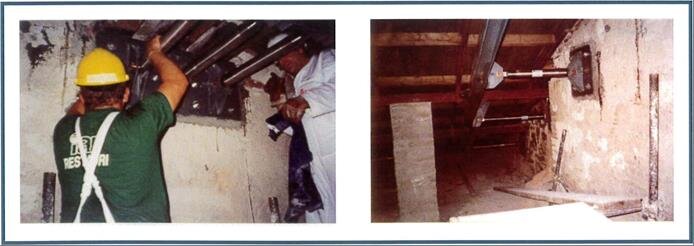
THE FORM MEMORY ALLOY TO REALIZE ANTI-SYMIC BINDING DEVICES FOR THE FACADES OF THE CHURCHES
SMAD's Shape Memory Alloy Devices
Innovative technologies for architectural conservation
SMADs is a nickel-titanium alloy that has the characteristic of absorbing and dissipating inside the seismic energy that hits the building; this behavior is highly different from that of steel, which instead accumulates and violently returns the energy that is transmitted to itself by the earthquake, if it does not exceed the elastic field, causing serious damage that can lead to collapse.
The motion of the nickel-titanium atoms that generate this phenomenon does not cause the breaking of crystal lattices as occurs instead in the deformation of the steel when it exceeds the elastic field, which then deforms irreversibly and the steel tie becomes completely ineffective.
When the seismic stress ceases, the shape memory alloy resumes its initial shape without having suffered damage to its crystalline structure; this phenomenon occurs in tenths of a second, therefore the shape memory alloy manages to cope with seismic shocks repeating even in the very short period.
Vibration table tests conducted by ENEA (National Agency for New Technologies, Energy and Sustainable Development) on masonry models have shown that tie rods made with the Shape Memory Alloy reduce acceleration by preventing collapse due to forces orthogonal to the plan also of the upper part of the masonry, assimilated to the tympanum of the churches; walls are able to withstand forces higher than 50% of those that cause the collapse of façades with tympanum reinforced with the classic metal tie rods.
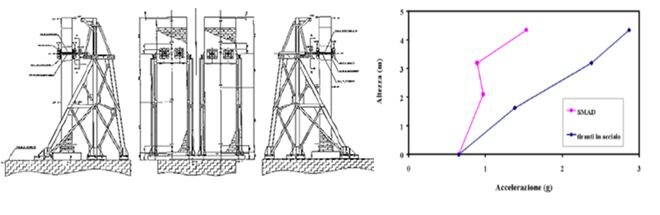
The diagram shows the maximum values of the accelerations that caused the wall , with steel tie rods to collapse, colour blue, while the wall, with the SMADs tie rods has perfectly resisted, colour red.
SMADs are used to mitigate one of the major causes of church vulnerability, which consists in overturning the facade caused by forces orthogonal to the plan.
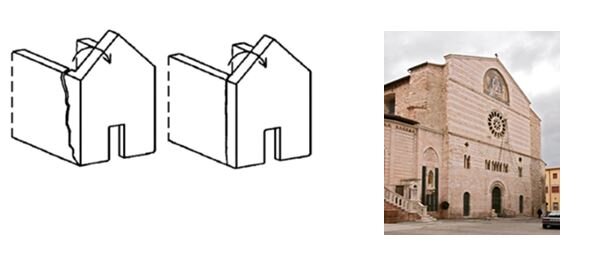
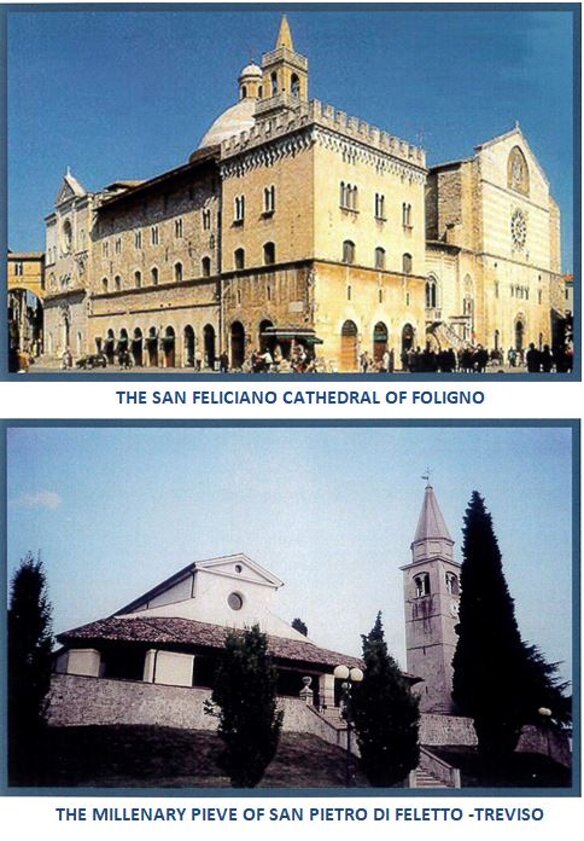
With SMADs, we have bound, for the year 2000 Jubilee, the facade of the of SAN FELICIANO cathedral in Foligno (Umbria), which has perfectly resisted the numerous earthquakes that have occurred in the area after 2000.